The Board Is a Billboard: What Your Airport Perfume Really Costs After the Card Fees
You are standing at a perfume counter in Terminal 5. The tester is pleasant, the bottle is handsome, and the shelf price says €92. The currency board above the till says €1 buys £0.86, so your brain does a quick flick: about £79. Lovely. You tap your card. A week later the statement lands and the bottle has cost you £85.12. Nothing has gone wrong, exactly. You have simply paid the difference between a billboard and a bank statement.
The board is a billboard, not a receipt
Airport currency boards are there to make foreign prices feel manageable. They usually show a round, friendly rate — sometimes close to the mid-market rate you see on Google, sometimes not close at all. What they do not show is the rate your card issuer will use when the transaction settles, or the fee your bank will bolt on for the privilege of spending in another currency. Those two numbers, not the board, decide what the perfume actually costs you.
This matters more in travel retail than almost anywhere else, because the whole appeal of an airport buy is the idea that you are saving money. A €92 fragrance that lands at £85 is still a decent deal if the same bottle is £95 on the high street. It is a rotten deal if you could have bought it in the UK for £78. The trick is to compare landed cost with UK price, not shelf price with board rate.
Three leaks between the shelf and your statement
1. The non-sterling transaction fee
Most UK debit and credit cards charge a fee for purchases in a foreign currency — typically 2.5% to 3%, sometimes with a minimum charge. Some travel-friendly current accounts and credit cards charge nothing, or close to it. The difference is not academic. On a €92 bottle, 2.75% is roughly £2.20. On a €200 gift set it is nearer £5. Check your card's terms before you fly: search for “non-sterling transaction fee” or “foreign purchase fee” in the app. If your everyday card charges 3%, use it for the coffee and keep the perfume for a fee-free card.
2. Dynamic currency conversion at the till
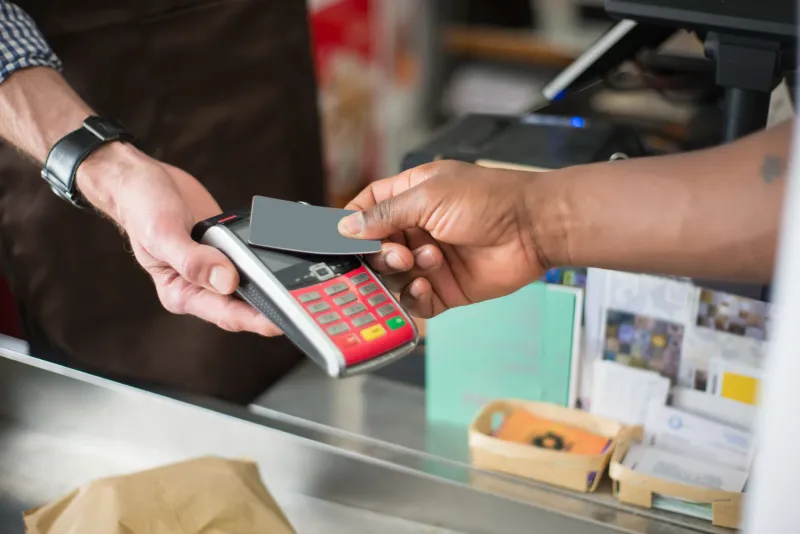
This is the one that catches people. The card machine offers to charge you in pounds instead of euros. It feels helpful — no maths, no foreign currency — but the exchange rate used for that conversion usually includes a markup of 3% to 6%, and sometimes a flat fee on top. You are paying for convenience twice: once in the markup, and again if your card still treats it as an overseas transaction. The fix is simple and slightly awkward: say “in euros, please” or tap the local-currency option. Always. Even if the assistant looks at you as if you have asked for something unusual.
3. Refunds and reversals
Returns are rare in airport duty free, but they happen — wrong bottle, damaged box, a change of heart at the gate. If you bought in euros and the refund is processed in euros, your card converts it back at the rate on the refund date. If the pound has weakened since you bought, you get fewer pounds back. Some retailers refund in sterling at their own rate, which can be worse. Keep the receipt, ask for the refund in the original currency, and accept that the round trip may cost you a few pounds even when the retailer is perfectly fair.
The 30-second pre-till calculation
You do not need a spreadsheet. You need three numbers and a rough idea of your card's fee.
- Local price: the number on the shelf, in the currency you will actually be charged.
- Your card's FX fee: 0% if you have a travel card, 2.5–3% if you do not.
- The board rate: use it as a rough guide, then add a small buffer — say 1% — because your card's rate will not be identical.
So: local price × board rate × (1 + card fee + 1% buffer). If the board says €1 = £0.86, a €92 bottle looks like £79.12. Add 2.75% card fee and a 1% buffer and you get roughly £81.10. That is your working estimate. If the till offers to charge you £84.50 in sterling via dynamic currency conversion, you now know it is the worse option by a clear margin.
A fee-free card changes the sum nicely. Same €92 bottle, no FX fee, 1% buffer: about £79.90. That is the real saving an airport can deliver — not the difference between €92 and £92 on a board, but the difference between a sensible card and a costly one.
The airport wrinkles worth knowing
UK airports price in pounds, so a UK card usually avoids the currency question altogether. The fun starts when you are buying in the EU or the US and the shelf price is in euros or dollars. Eurostar and continental airports are full of tempting perfume counters, and the same rules apply: pay in the local currency, decline the sterling conversion, and know your card's fee.
Multi-currency cards and fintech accounts are useful, but check the small print for weekend markups and fair-use limits. Pre-order and collect services can be charged at the point of collection or dispatch, which may mean the payment is processed abroad even if you ordered from your sofa in Manchester. And tax-free refunds, where they apply, often travel back through the same currency pipe — a refund in euros converted to pounds, with a spread built in somewhere along the line.
The bottom line
The currency board is not lying, exactly. It is just not quoting your price. Your price is the shelf price, converted at your card's rate, plus your card's fee, with any dynamic currency conversion firmly declined. Do that sum before you reach the till and the airport perfume buy becomes what it should be: a genuine saving, not a glossy number that evaporates on the statement.